Toy Airplane: 56 High-Fidelity PNGs for Dynamic Design
When we think about capturing the essence of childhood wonder in a professional setting, the challenge usually lies in the quality of the assets. You need high-resolution imagery that doesn't pixelate on large-format prints, but you also need the flexibility to manipulate the design without destroying the background. This is where the Toy Airplane asset pack enters the conversation. It isn't just a collection of stock photos; it is a curated set of 56 distinct illustrations rendered at a massive 8000x6000 pixels and 450dpi, provided in PNG format with transparent backgrounds.
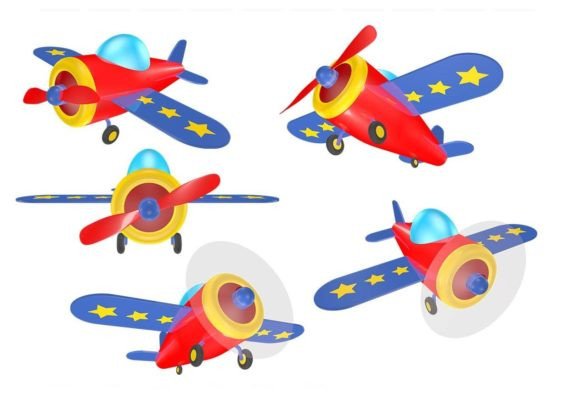
For the graphic designer, author, or entrepreneur, this specific configuration changes the workflow significantly. You aren't spending hours masking out backgrounds in Photoshop or dealing with messy edges in Canva. You are working with studio-ready assets that are immediately composable. The visual style of these airplanes strikes a balance between realistic texture and stylized charm. They possess the tactile quality of molded plastic and die-cast metal—think of the classic toys from the mid-20th century—but rendered with the crispness of modern digital illustration.
Visual Characteristics and Narrative Potential
The "personality" of the Toy Airplane collection is distinctly nostalgic yet accessible to modern audiences. The design avoids the hyper-realistic look of a technical blueprint, which can feel cold, and instead embraces a warmth that invites storytelling. The color palettes appear grounded in reality—classic reds, blues, and metallic silvers—but the lighting and shadow work are subtle enough to allow for easy color grading if your project requires a different mood.
What makes this collection particularly valuable for children’s books and animation is the inclusion of two distinct motion states: stationary propellers and motion simulation. This is a crucial detail for visual storytelling. In a children's book layout, you might use the stationary version for a moment of quiet contemplation, perhaps when the pilot is boarding or the plane is resting on a runway. Conversely, the motion-blur propellers instantly convey speed, action, and adventure. This allows you to build a visual hierarchy within your page layouts, using static imagery to guide the reader's eye and dynamic imagery to inject energy into the scene.
Practical Applications Across Industries
The utility of a high-quality Toy Airplane asset extends far beyond the obvious application in children's literature. If you are a small business owner in the travel or logistics sector, these images can serve as a playful alternative to the standard, sterile corporate photography often used in marketing materials. They soften the brand identity, making a company appear more approachable and human.
For content creators and bloggers, these assets are a goldmine for social media graphics. The transparent background allows you to overlay the plane onto text-heavy backgrounds without creating visual clutter. Imagine a travel blogger using the motion-simulation plane as a header image for a "Wanderlust" series, or a marketing agency using it in a presentation to symbolize "taking your business to new heights." The versatility here is the selling point; it is a creative font for the eyes, adaptable to various contexts.
Technical Considerations for Designers
From a technical standpoint, working with 8000x6000 pixel assets at 450dpi requires a bit of forethought. This resolution is massive, designed specifically for print production. If you are creating a poster, a banner, or a physical book cover, you have absolute freedom to crop, zoom, and recompose without losing sharpness. However, if your primary output is web design or social media graphics, you will need to downscale these images.
It is worth noting that while these are raster images (PNGs), not vector files, the high resolution mitigates most scalability concerns. You can resize them significantly in software like Adobe Illustrator or Affinity Designer without visible degradation. When integrating these into your layout, consider how they interact with your typography. A playful, handwritten font might pair well with the toy aesthetic, but be careful not to overdo the whimsy. A clean sans-serif font can provide a nice counterbalance, grounding the playful imagery with professional legibility.
Strategic Asset for Brand Consistency
Consistency is the bedrock of strong brand identity. Having a library of 56 images from the same set ensures that your visual language remains uniform. You aren't mixing and matching different illustration styles or lighting conditions, which can make a project look disjointed. Whether you are designing a series of social media posts, a multi-page catalog, or an animated explainer video, the Toy Airplane collection provides a cohesive visual thread.
For entrepreneurs looking to create merchandise—perhaps printed t-shirts, mugs, or stickers—the transparent background is non-negotiable. It allows the design to sit cleanly on any product color or texture. The "in-motion" images work particularly well for merchandise that aims to evoke a sense of fun and activity, while the stationary images might be better suited for logos or app icons where clarity is paramount.
Ultimately, the value of this asset lies in its versatility and quality. It solves the common problem of finding high-quality, thematic imagery that doesn't look like generic stock photography. It offers a specific aesthetic that can be adapted to suit a wide range of creative needs, from the whimsical pages of a picture book to the professional decks of a corporate presentation.